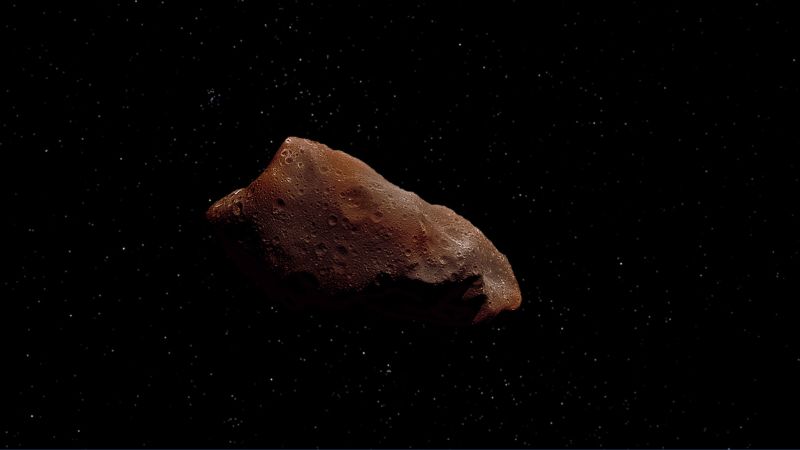
The space rock came within 79,000 miles (127,000 kilometers) of Earth, or about one-third of the distance between the moon and Earth, according to NASA's Center for Near Earth Object Studies .
Named 2022 GN1, it was estimated to be 24.3 to 55.8 feet (7.4 to 17 meters) long and was traveling at 34,695 miles per hour (55,836 kilometers per hour), according to CNEOS .
Asteroid Bennu's mysterious missing craters suggest 'impact armoring' protecting the surface | Space
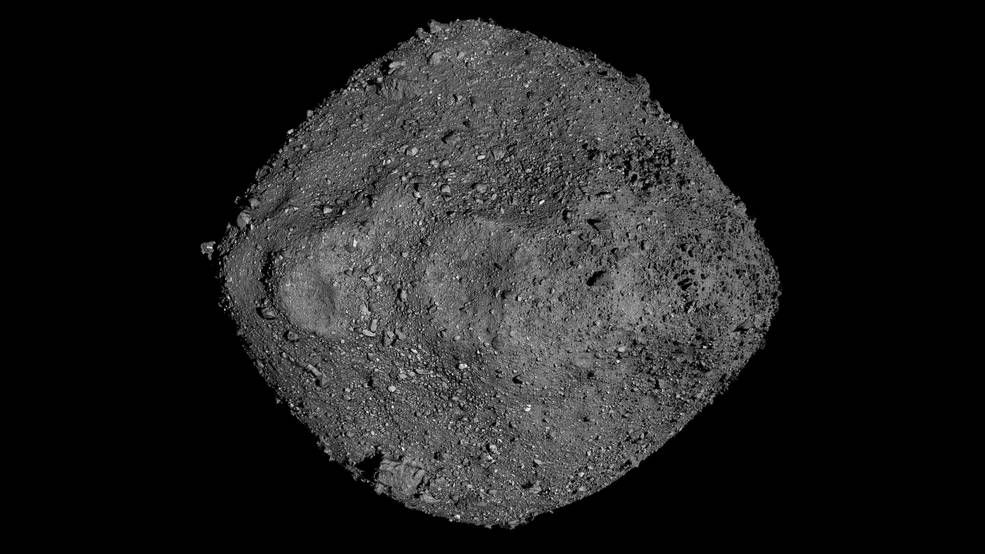
The surface of asteroid Bennu is riddled with craters. But data from NASA's OSIRIS-REx mission show that, in fact, many craters are missing.
NASA's OSIRIS-REx spacecraft spent nearly two and a half years between 2018 and 2021 studying near-Earth asteroid Bennu .
This amount of data and images has made Bennu one of the best explored bodies in the solar system , Edward "Beau" Bierhaus, a space science researcher at Lockheed Martin and lead author of a new paper detailing the findings told Space.com.

This astronomer turns small Eastern European country into an asteroid-spotting powerhouse | Space

The vast majority of asteroids potentially threatening our planet are discovered by NASA-funded telescopes. The second spot currently belongs to Hungary, a tiny Eastern European country with less than 10 million inhabitants.
This unexpected prominence is mostly down to one man — Krisztián Sárneczky — an astronomer who made headlines last month by discovering a small space rock that was just about to hit Earth . Sárneczky's success, however, has been achieved against many odds.
Economics of the Stars: The Future of Asteroid Mining and the Global Economy
As the consequences of environmental degradation and natural resource depletion become increasingly severe, scientists are placing a greater emphasis on not only sustainably utilizing the resources that we already have, but also on identifying new methods of obtaining resources.
Although proposed many times, the first tangible effort to enable the exploration and development of asteroid mining came in 2012 from Planetary Resources, a Seattle-based aerospace company. Planetary Resources were then closely followed by a similar company, Deep Space Industries.

Astronomers shed light on 'God of Chaos' asteroid Apophis ahead of Earth flyby in 2029

The space rock Apophis is as big as the Empire State Building and is expected to make a close pass of Earth in 2029.
Apophis was discovered in 2004 and was for a while believed to be on a collision course with our planet.
An analysis of the object's orbit last year revealed, however, that Earth is safe from impact for at least the next century.

NASA's Asteroid Mission Receives Space Foundation's Exploration Award | NASA

US Space Force Releases Decades of Bolide Data to NASA for Planetary Defense Studies

This photograph taken by an International Space Station astronaut shows a bright meteor from the Perseid meteor shower in Earth's atmosphere. The brightest meteors are known as fireballs, or bolides.
Hosted by JPL's Center for Near Earth Object Studies, the data can be used by the science community to better understand how asteroids break up when entering the atmosphere.
The space rock came within 79,000 miles of Earth, or about one-third of the distance between the moon and Earth, ac… https://t.co/EpouRsngSb CNN Wed Apr 06 21:41:45 +0000 2022
The space rock came within 127,000 kilometers of Earth, or about one-third of the distance between the moon and Ear… https://t.co/URH0Ds88lH cnni (from Everywhere) Wed Apr 06 21:41:45 +0000 2022

No comments:
Post a Comment